Buy your meat and eggs from local farmers. Don't support the market pressures that create monsters like Austin DeCoster, now responsible for a national outbreak of salmonella and nearly half a billion eggs being recalled from the market, due to the appalling conditions of his "farms".
Sure, local meat costs a lot more, but think about what makes 99-cents-a-dozen-eggs even possible. Before the environmentally destructive practice of concentrated animal feeding operations (CAFOs) became commonplace, eating meat for the vast majority of us was far more a luxury as demand far outstripped supply, and most eggs came from the backyard hen house.
The costs you "save" by buying factory farmed meat and eggs are merely being passed on to the communities and exploited workers affected by the producers unethical practices.
In the summer months most neighborhood farmers markets feature local producers - Black Earth Meats, for example. Another option is to join a meat CSA or co-op, such as the one at True Nature Foods in Edgewater, where you can have access to locally pastured, grass-fed beef, pork, and chicken, as well as fresh eggs.
The shells are much stronger and the yolks a bright orange from the levels of beta carotene in their diet. The beef cooks faster and has a more wild taste from the abundance of grass it eats that the animal evolved to consume. Also, consider that corn-fed beef is far more likely to contain stomach-acid-resistant e. Coli bacteria, since the environment of a corn-packed rumen (the organ that converts grass to protein) is highly acidic. The outbreaks of this pathogen are not coincidental with the rise of CAFOs.
CAFOs also present some of the most dangerous working conditions imaginable, and take advantage of illegal migrant labor.
Showing posts with label Local. Show all posts
Showing posts with label Local. Show all posts
Wednesday, August 25, 2010

Wednesday, April 14, 2010
In search of a better burger
After I started this blog and linked it to my twitter account, I soon connected with several grass-fed beef advocates, such as The Meat Goat and Only Grass-fed. One day The Meat Goat tweeted about Duke O'Brien's Alehouse in Crystal Lake, and their burger special that night, featuring the grass-fed beef The Meat Goat distributes, from Black Earth Meats, in Madison, Wisconsin.
Noticing that the Metra station was just across the street from Duke's, I thought a trip up there could be a perfect weekend adventure. And what a better counterpoint to a thousand calorie dinner than a thousand calorie bike ride? Taking advantage of Google's new bicycling option for maps directions, I found a nice 10 mile route to nearby Moraine Hills State Park. Metra allows bikes on the trains during off-peak hours, so plans were made.
Patty and I packed a simple picnic lunch of some leftovers from a barbecue the night before, plus a little cheese and some PBRs. Then we caught the 12:45 north bound Union Pacific Northwest Line out of the Irving Park station.

The ride to the park could only have been more perfect if it was all on bike path, instead of just 80 percent trail. We rode north on the Prairie Path Trail (and up and down some pretty substantial hills, considering I had my girlfriend in tow!) to Bull Valley Road, and then took that east to the junction with the S. River Road bike trail, which skirted the edge of Moraine Hills State Park.
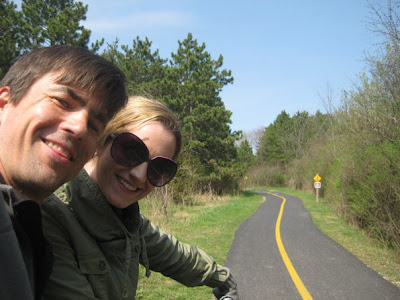
Inside is a five mile loop of crushed limestone over more hills and past wetlands traversed by a maze of boardwalk. We dismounted and walked the bikes out to some benches by the waterfront; then enjoyed some PBR and our light lunch.
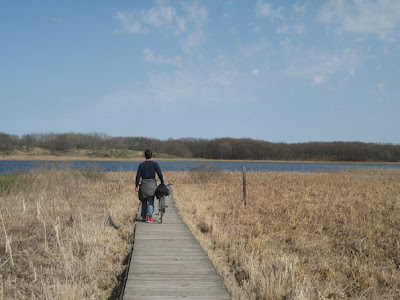
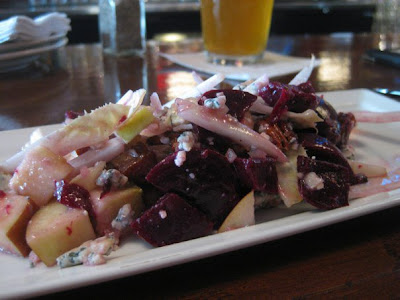
After an hour or so inside the park, riding and eating, we returned to Crystal Lake and found a seat at the bar of Duke's Alehouse, and ordered two Tallgrass burgers, made with Black Earth Farms grass-fed beef. We also split the beet salad, which included endives, pears and Gorgonzola (always a great pairing), and pecans. I had a salad, Patty the sweet-potato fries, and we shared both, as well.
Grass-fed beef has much healthier fats, rich in unsaturated and omega-3, due to the cow's exclusive diet of leafy green grass, rather than omega-6 and empty-calorie packed corn. Grass-finished beef cooks faster, and has a tangy, almost nutty flavor, like bison, dense with protein. The burger, served medium-rare on a pretzel roll, did not disappoint. I had farm-produced cheddar on mine, Patty chose Gouda.

A perfect way to spend a Sunday afternoon with a loved one, enjoying the misunderstood and seldom experienced unique items such as Duke's and bike paths that the suburbs have to offer.
Noticing that the Metra station was just across the street from Duke's, I thought a trip up there could be a perfect weekend adventure. And what a better counterpoint to a thousand calorie dinner than a thousand calorie bike ride? Taking advantage of Google's new bicycling option for maps directions, I found a nice 10 mile route to nearby Moraine Hills State Park. Metra allows bikes on the trains during off-peak hours, so plans were made.
Patty and I packed a simple picnic lunch of some leftovers from a barbecue the night before, plus a little cheese and some PBRs. Then we caught the 12:45 north bound Union Pacific Northwest Line out of the Irving Park station.

The ride to the park could only have been more perfect if it was all on bike path, instead of just 80 percent trail. We rode north on the Prairie Path Trail (and up and down some pretty substantial hills, considering I had my girlfriend in tow!) to Bull Valley Road, and then took that east to the junction with the S. River Road bike trail, which skirted the edge of Moraine Hills State Park.

Inside is a five mile loop of crushed limestone over more hills and past wetlands traversed by a maze of boardwalk. We dismounted and walked the bikes out to some benches by the waterfront; then enjoyed some PBR and our light lunch.

After an hour or so inside the park, riding and eating, we returned to Crystal Lake and found a seat at the bar of Duke's Alehouse, and ordered two Tallgrass burgers, made with Black Earth Farms grass-fed beef. We also split the beet salad, which included endives, pears and Gorgonzola (always a great pairing), and pecans. I had a salad, Patty the sweet-potato fries, and we shared both, as well.

Grass-fed beef has much healthier fats, rich in unsaturated and omega-3, due to the cow's exclusive diet of leafy green grass, rather than omega-6 and empty-calorie packed corn. Grass-finished beef cooks faster, and has a tangy, almost nutty flavor, like bison, dense with protein. The burger, served medium-rare on a pretzel roll, did not disappoint. I had farm-produced cheddar on mine, Patty chose Gouda.

A perfect way to spend a Sunday afternoon with a loved one, enjoying the misunderstood and seldom experienced unique items such as Duke's and bike paths that the suburbs have to offer.
Tuesday, March 16, 2010
Volunteering at the Family Farmed Expo
5 AM came pretty early Saturday morning, the day of the Family Farmed Expo; a sort of trade show for local food growers and consumers being held at the UIC Forum, beginning Thursday, March 11th.
Because of work obligations, Patty and I weren't able to attend the previous two days, and very regrettably missed the Localicious party on Friday night, a sampling of the offerings from the exhibitors as well as local restaurants and celebrity chefs using local and organic ingredients. However, we were very excited to sign up to volunteer, so much so that we grabbed the 7:30-10:30 AM slot, and after hitting the snooze a few times we were out the door on our bikes into a rainy, blustery morning, in search of coffee before arriving at the Expo. Thankfully, Daylight Savings Time didn't start until the next day, otherwise we'd be leaving in total darkness, as well.
Caffeinating at the Caribou down the street from the Forum on Halsted:

After getting a bit lost in the hallways of the forum, we pushed open enough doors to hear the growing activity of the Expo from the main showroom. We checked in, and while Patty left to go spread linens over the exhibitor booths,...
I went to help the registration booth prep for an expected attendance of over 2,500 Expo attendees...

After sorting Expo programs into paper bags in which attendees could carry exhibitor items and collateral, and tearing wrist bands for easier access during the pre-opening lull, it got very busy, very fast. I simply checked attendees at will call, while other volunteers signed in exhibitors, guests, and took day-of sales, as well. For the last hour of our shift, Patty directed people at the door to the appropriate lines.
I hate it when the volunteer signed up for the next shift is late, and luckily today that wasn't the case at all. I actually had 15 minutes to show her the ropes before putting on a wrist band of my own, grabbing Patty and couple of bags, and wading into the festival, now going at full-bore:
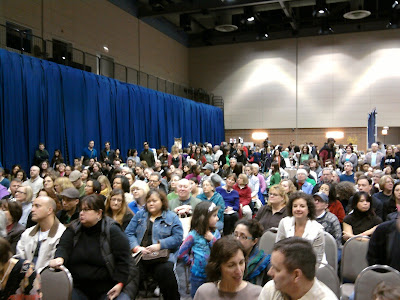
We browsed the booths: looking at CSA options (I chose one: Farmer Tom's - I'm not yet ready to drop $700-900 on a full share right now, so this one allows me to buy weekly, with a small annual membership fee. I get organic produce year round, and locally grown when in season), and chatting with soap vendors, grass-fed beef and dairy producers; sampling barbecue, cheese, microgreens, and locally-made honey, mustard, ketchup (bought a bottle), and salsa.
I picked up a copy of edible Chicago, a free guide to seasonal, local foods in the area. Patty bought some dog shampoo for Jack (he smells great). And know this: if you haven't tried Traders Point Creamery's grass-fed yogurt and cheese, you are really missing out.
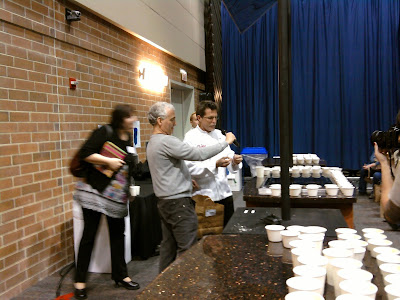
Celebrity chef Rick Bayless serving up some locally-sourced soup to the crowd after his workshop:
Because of work obligations, Patty and I weren't able to attend the previous two days, and very regrettably missed the Localicious party on Friday night, a sampling of the offerings from the exhibitors as well as local restaurants and celebrity chefs using local and organic ingredients. However, we were very excited to sign up to volunteer, so much so that we grabbed the 7:30-10:30 AM slot, and after hitting the snooze a few times we were out the door on our bikes into a rainy, blustery morning, in search of coffee before arriving at the Expo. Thankfully, Daylight Savings Time didn't start until the next day, otherwise we'd be leaving in total darkness, as well.
Caffeinating at the Caribou down the street from the Forum on Halsted:

After getting a bit lost in the hallways of the forum, we pushed open enough doors to hear the growing activity of the Expo from the main showroom. We checked in, and while Patty left to go spread linens over the exhibitor booths,...

I went to help the registration booth prep for an expected attendance of over 2,500 Expo attendees...

After sorting Expo programs into paper bags in which attendees could carry exhibitor items and collateral, and tearing wrist bands for easier access during the pre-opening lull, it got very busy, very fast. I simply checked attendees at will call, while other volunteers signed in exhibitors, guests, and took day-of sales, as well. For the last hour of our shift, Patty directed people at the door to the appropriate lines.
I hate it when the volunteer signed up for the next shift is late, and luckily today that wasn't the case at all. I actually had 15 minutes to show her the ropes before putting on a wrist band of my own, grabbing Patty and couple of bags, and wading into the festival, now going at full-bore:

We browsed the booths: looking at CSA options (I chose one: Farmer Tom's - I'm not yet ready to drop $700-900 on a full share right now, so this one allows me to buy weekly, with a small annual membership fee. I get organic produce year round, and locally grown when in season), and chatting with soap vendors, grass-fed beef and dairy producers; sampling barbecue, cheese, microgreens, and locally-made honey, mustard, ketchup (bought a bottle), and salsa.
I picked up a copy of edible Chicago, a free guide to seasonal, local foods in the area. Patty bought some dog shampoo for Jack (he smells great). And know this: if you haven't tried Traders Point Creamery's grass-fed yogurt and cheese, you are really missing out.
Celebrity chef Rick Bayless serving up some locally-sourced soup to the crowd after his workshop:

Tuesday, January 26, 2010
Waiting for spring
Not much to report, since not much is growing yet, so I thought I'd share a few things in the meantime.
Sunday I visited the Local Harvest Winter Farmer's Market just around the corner from my Irving Park apartment. I didn't buy anything, because there was nothing I immediately needed, but I noticed I am starting to recognize a lot of the vendors. There was local lamb, grains, and microgreens for sale, as well as organic tomato salsas and baked goods. I also saw locally produced denim and mattress-tops, interesting enough.
I learned that most CSA shares will not be available until June 1st, and that I have until April to decide on one and still get a sizable early-opt-in discount. It will be pricy however: some full season shares cost as much as $800 for produce, and $900 for meat. However, either could easily be split between two people, or even among three. I will do a bit more research on size and quantity, but I think I will choose a CSA that doesn't require a long-term commitment since there are many times I'll be traveling this year for bike racing.
I have also decided that until then, I'll be planning my garden, both outdoor and indoors, and will be making a composter soon. (Thanks to Natalie for the link.)
Finally, Michael Pollan has a new book coming out and was featured in "10 Questions" for the most recent issue of Time.
Sunday I visited the Local Harvest Winter Farmer's Market just around the corner from my Irving Park apartment. I didn't buy anything, because there was nothing I immediately needed, but I noticed I am starting to recognize a lot of the vendors. There was local lamb, grains, and microgreens for sale, as well as organic tomato salsas and baked goods. I also saw locally produced denim and mattress-tops, interesting enough.
I learned that most CSA shares will not be available until June 1st, and that I have until April to decide on one and still get a sizable early-opt-in discount. It will be pricy however: some full season shares cost as much as $800 for produce, and $900 for meat. However, either could easily be split between two people, or even among three. I will do a bit more research on size and quantity, but I think I will choose a CSA that doesn't require a long-term commitment since there are many times I'll be traveling this year for bike racing.
I have also decided that until then, I'll be planning my garden, both outdoor and indoors, and will be making a composter soon. (Thanks to Natalie for the link.)
Finally, Michael Pollan has a new book coming out and was featured in "10 Questions" for the most recent issue of Time.
Monday, January 11, 2010
On a mission
I told you I was going crazy.
This new blog is the next step in a long, hopefully life-long, journey to a more wholesome me. When I say "wholesome" it brings to mind images of Normal Rockwell paintings, my mom's rhubarb pie, hot afternoons on my dad's old horse farm, or picturesque fields in which grow a bounty of nature's produce - kissed with dew and framed by misty mountains, a rustic fence, and a windmill, such as you'd see on a package of pre-washed lettuce or a carton of 79 cent eggs.
I want to emphasize the root word here, whole.
As in, "whole food."
Not "Whole Foods." There is a much larger difference between the above and a box of locally, ethically produced and distributed bag of lettuce or carton of eggs than the price points of Jewel and the popular organics juggernaut. The people who know and reject what goes into producing a dozen eggs that retail for less than a dollar don't realize that much hasn't changed with the $4.59 option.
This is not a reaction against that fine establishment - I hardly shop there - but halfway through Michael Pollan's The Omnivore's Dilemma I had decided enough was enough. I'd decided that, knowing all that I know since first reading Fast Food Nation in 2001, to continue partaking in a system that I know is wrong is to be nothing less than a sociopath.
This year I will attempt to live on locally produced food as much as possible, here in the great city of Chicago, and document it here in this space. I know this will be harder than it seems. For I live in a large American city where convenience is everything, and none of my neighbors are farmers. How can I do this practically, within my existing budget, staying carless and true to my 20 minute neighborhood ideal?
I had long ago banished the frozen meals, the packaged pasta dishes, canned soup, or low-fat this and low-salt that. In doing so I shed over 70 pounds and ushered in what has so far been the golden age of my life. That was the easy part. Most of it is nothing but corn anyways. The end product from the tap of a torrent of government-subsidized, genetically modified corn. Never trust a corporation to feed you.
However, our beef, chicken, pork - and even our fish! -are forced to feed against their nature from the same river of cheap calories, forced into a life that not even under the most liberal of interpretations would be considered humane.
Cows are meant to eat grass. Feeding them corn causes them to get sick. So does keeping them packed together in conditions that are worse than a concentration camp. So does forcing them to wallow around in their own shit for the final weeks of their lives. Hormones and antibiotics are necessary in order to profitably raise them this way.
Chickens have it just as bad. Never allowed to so much as walk in most conventional operations and bred for their meat, their breasts grow so large they can't even stand up. Pigs - just as smart an animal as your pet dog - are treated the same, too. And fish - our prized salmon, carnivorous animals that get their pink flesh from their diet of ocean krill and shrimp - are now being bred to eat much cheaper corn in farming pens, while their pasty white meat is dyed their natural color in one of the supermarket's biggest lies.
But the worst of it is, with all that corn and those unnatural living conditions, you'd be better off eating cardboard. Mr. Pollan is able to explain this much better than I can in his seminal essay, "Unhappy Meals" but, in summary, the nutritional result of all this engineering to grow our food for greater and greater profits is not at all to our own benefit.
So in a moment of clarity, I found the inspiration to begin the project that will be documented in this blog. His words are so often quoted, hollow and empty most of the time, but in that instant they intoned with absolute truth:
"Be the change that you want to see in the world."
What Mahatma Gandhi meant was that we have change ourselves, not the world.
So in addition to creating this blog in an attempt to influence each of you, I will back up my words with action.
As I said, I have already gone a couple years since last buying a prepackaged meal. I haven't bought supermarket meat in a few months as well, instead choosing to buy what little meat I do now eat at the Logan Square farmer's market from a producer called Black Earth Farms. Free range eggs have been occupying space in my fridge as well as organic yogurt and tofu.
While I was moved beyond words by the plight of the industrially produced cow or pig, I still reject the vegan's utopia. Domesticated animals do not exist by man's hand alone. Those animals - cows, pigs, chickens, dogs, horses, I could go on - found that their own survival was perpetuated by a symbiotic relationship with humans, and so, in effect, "chose" to become domesticated as much as we chose to base our society around them.
As Mr. Pollan so eloquently demonstrated with the Polyface Farm in Dilemma, ending up as a food source for humans is a pretty fair trade for being allowed to live your life as nature intended, grazing on dewy grass as a cow, scratching your back satisfyingly against the rough bark of a pine tree as a pig, or digging for grubs in dried up manure as a chicken.
This naturally produced food does cost more... or does it? We indeed pay more up front and in the open, rather than farther down the line for conventional food, and the hidden costs of its agricultural pollution, massive carbon footprint, and health ramifications associated with poor nutrition blown out on a national scale now approaching a national emergency.
"Eat food. Not too much. Mostly plants," Pollan tells us in Unhappy Meals. Eat less of better food.
And so I will. For knowing what I now know, doing anything less would be unconscionable.
Coming up:
I'll detail my practical approach to this effort and set down a few rules and exceptions for myself.
I will review of two new co-op grocery stores, New Leaf Natural Grocery of Roger's Park and The Dill Pickle in Logan Square, along with the now-indoors for the winter Logan Square Farmer's Market, and detail my search for a CSA (Community Supported Agriculture) membership.
Over the course of the coming months, the main focus of this blog will be on the practicality (or impracticality, is it may turn out) of living locally, seasonably, and sustainably, whatever that means.
And I aim to find out.
This new blog is the next step in a long, hopefully life-long, journey to a more wholesome me. When I say "wholesome" it brings to mind images of Normal Rockwell paintings, my mom's rhubarb pie, hot afternoons on my dad's old horse farm, or picturesque fields in which grow a bounty of nature's produce - kissed with dew and framed by misty mountains, a rustic fence, and a windmill, such as you'd see on a package of pre-washed lettuce or a carton of 79 cent eggs.
I want to emphasize the root word here, whole.
As in, "whole food."
Not "Whole Foods." There is a much larger difference between the above and a box of locally, ethically produced and distributed bag of lettuce or carton of eggs than the price points of Jewel and the popular organics juggernaut. The people who know and reject what goes into producing a dozen eggs that retail for less than a dollar don't realize that much hasn't changed with the $4.59 option.
This is not a reaction against that fine establishment - I hardly shop there - but halfway through Michael Pollan's The Omnivore's Dilemma I had decided enough was enough. I'd decided that, knowing all that I know since first reading Fast Food Nation in 2001, to continue partaking in a system that I know is wrong is to be nothing less than a sociopath.
This year I will attempt to live on locally produced food as much as possible, here in the great city of Chicago, and document it here in this space. I know this will be harder than it seems. For I live in a large American city where convenience is everything, and none of my neighbors are farmers. How can I do this practically, within my existing budget, staying carless and true to my 20 minute neighborhood ideal?
I had long ago banished the frozen meals, the packaged pasta dishes, canned soup, or low-fat this and low-salt that. In doing so I shed over 70 pounds and ushered in what has so far been the golden age of my life. That was the easy part. Most of it is nothing but corn anyways. The end product from the tap of a torrent of government-subsidized, genetically modified corn. Never trust a corporation to feed you.
However, our beef, chicken, pork - and even our fish! -are forced to feed against their nature from the same river of cheap calories, forced into a life that not even under the most liberal of interpretations would be considered humane.
Cows are meant to eat grass. Feeding them corn causes them to get sick. So does keeping them packed together in conditions that are worse than a concentration camp. So does forcing them to wallow around in their own shit for the final weeks of their lives. Hormones and antibiotics are necessary in order to profitably raise them this way.
Chickens have it just as bad. Never allowed to so much as walk in most conventional operations and bred for their meat, their breasts grow so large they can't even stand up. Pigs - just as smart an animal as your pet dog - are treated the same, too. And fish - our prized salmon, carnivorous animals that get their pink flesh from their diet of ocean krill and shrimp - are now being bred to eat much cheaper corn in farming pens, while their pasty white meat is dyed their natural color in one of the supermarket's biggest lies.
But the worst of it is, with all that corn and those unnatural living conditions, you'd be better off eating cardboard. Mr. Pollan is able to explain this much better than I can in his seminal essay, "Unhappy Meals" but, in summary, the nutritional result of all this engineering to grow our food for greater and greater profits is not at all to our own benefit.
So in a moment of clarity, I found the inspiration to begin the project that will be documented in this blog. His words are so often quoted, hollow and empty most of the time, but in that instant they intoned with absolute truth:
"Be the change that you want to see in the world."
What Mahatma Gandhi meant was that we have change ourselves, not the world.
So in addition to creating this blog in an attempt to influence each of you, I will back up my words with action.
As I said, I have already gone a couple years since last buying a prepackaged meal. I haven't bought supermarket meat in a few months as well, instead choosing to buy what little meat I do now eat at the Logan Square farmer's market from a producer called Black Earth Farms. Free range eggs have been occupying space in my fridge as well as organic yogurt and tofu.
While I was moved beyond words by the plight of the industrially produced cow or pig, I still reject the vegan's utopia. Domesticated animals do not exist by man's hand alone. Those animals - cows, pigs, chickens, dogs, horses, I could go on - found that their own survival was perpetuated by a symbiotic relationship with humans, and so, in effect, "chose" to become domesticated as much as we chose to base our society around them.
As Mr. Pollan so eloquently demonstrated with the Polyface Farm in Dilemma, ending up as a food source for humans is a pretty fair trade for being allowed to live your life as nature intended, grazing on dewy grass as a cow, scratching your back satisfyingly against the rough bark of a pine tree as a pig, or digging for grubs in dried up manure as a chicken.
This naturally produced food does cost more... or does it? We indeed pay more up front and in the open, rather than farther down the line for conventional food, and the hidden costs of its agricultural pollution, massive carbon footprint, and health ramifications associated with poor nutrition blown out on a national scale now approaching a national emergency.
"Eat food. Not too much. Mostly plants," Pollan tells us in Unhappy Meals. Eat less of better food.
And so I will. For knowing what I now know, doing anything less would be unconscionable.
Coming up:
I'll detail my practical approach to this effort and set down a few rules and exceptions for myself.
I will review of two new co-op grocery stores, New Leaf Natural Grocery of Roger's Park and The Dill Pickle in Logan Square, along with the now-indoors for the winter Logan Square Farmer's Market, and detail my search for a CSA (Community Supported Agriculture) membership.
Over the course of the coming months, the main focus of this blog will be on the practicality (or impracticality, is it may turn out) of living locally, seasonably, and sustainably, whatever that means.
And I aim to find out.
Subscribe to:
Posts (Atom)